Howie

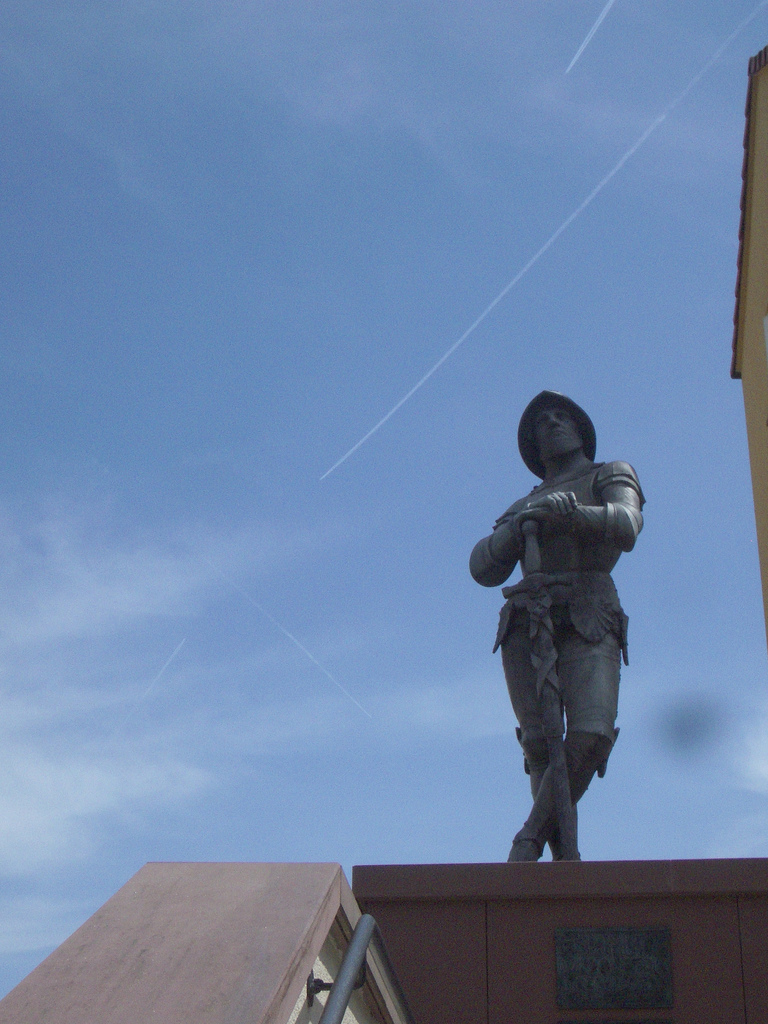
The Writing Workshop takes the day off today so we get a chance to present this nice cartton that Clara Soriano has made of my character in Mrs. Carrington.

Of course she’s the same artist that amazed us with her view of our protagonists.

Have a nice day!

The classics

He doesn't give a fiddler's fart about modern stuff like planes and reads classics only.

I always say I’m more into the classics, but I could be more precise. Most of my readings come from a relatively short stretch of about seventy years, from the last third of the 19th century until the mid-20th. I rarely venture further back in time, out of fear to feel overcome by the socio-cultural -or merely linguistic- distance. Thus, for example, I loved Shakespeare when I read him in college, but I indefinitely procastrinate reading more of his plays. The oldest thing I’ve ever read must have been “Lysistrata“, which felt a little slow but still makes me laugh every time I remember some lines from its chastity oath:

I’ll never lie and stare up at the ceiling,
Nor like a lion on all fours go kneeling.

from the Gutenberg Project edition

One of my favourite bloggers wrote recently:

I don’t think reading classics is so important. After all, if they were read in their time is because they knew no better. I read for fun. I don’t read to cultivate myself, or to become a better person, or to have conversation topics at hipster gatherings. I read for fun. That means my choice of reading material is determined by one basic factor -that they entertain me.

Well let me entertain you all with my disagreeing thoughts. Firstly, not everything that was read in the past has reached us today. Probably loads of lesser texts (or then-considered lesser) got lost along the way by lack of interest and -therefore- copies. Even with a bit of bad luck we might have lost some of the best ones, due to their audacity or rebeliousness, in bonfires across the centuries, be it in the depths of a medieval monastery, during witch hunts or at a nazi demonstration. Following our example, less than a fourth of the plays by Aristophanes survive today. The classics that we have are not all that there was. It’s just all that we have.

Secondly, I also disagree because classics can be entertaining in many ways. They come from differents times and cultures, so dumping them all in the same basket can be quite a mistake. I find most classics amusing for some reason or other. Sometimes you discover how old is a certain idea (a character in “The Clouds” already offends somebody else by showing him the finger, over 400 years before Christ), or how early a cliché was born that we still see as modern nowadays, from criticism to the monarchy to vampire myths. In other ocassions one discovers the meaning that certain words used to have and, by seeing them used in a different context, one can deduce how they came to evolve into their modern meaning. Quite often, in general, one can see how people lived in former times, as if you were watching a transdimensional edition of “Big Brother“.

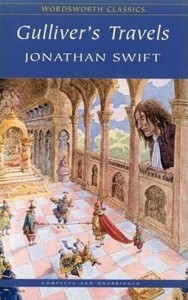
Aditionally, as writers, we owe a certain commitment to the literary tradition. For example, the novel that I’m working on describes a whole new universe, so for “documentation” purposes I enlarged my queue of readings with titles such as “Alice in Wonderland” or “Gulliver’s Travels”. The latter felt a little imposing because it was published as early as 1726 and I feared it wouldn’t have much to tell me. I’m finally reading it these days, and I have to say I’m impressed at the wide range of topics it touches upon. I happen to have a near-completed play whose characters have different sizes (imagine an Andalusian “Honey, I shrunk the kids“) and I have no joke in it that Jonathan Swift hasn’t already covered in his “travels” to Lilliput and Brobdingang. Moreover, his criticism of Western forms of government is just as valid today as it was almost three centuries ago.

In a word, I plan to widen my range of readings, which I hope will widen both my understanding of the world and the number of ways in which literature can amuse me. Are you willing to give it a try?

(Español) La novela colectiva

(Español) El valor del esfuerzo

Vigalondo pills

Nacho Vigalondo, the acclaimed director of The Time-Crimes (Cronocrímenes), is already promoting his forthcoming flick Extraterrestre. Luckily, instead of just telling us how nice everbybody in the team was and how much fun they had over the hard, hard shooting, he shares his expertise through these 5 pills of writer-director’s wisdom:

In a nutshell:

  1. Know what you’re telling. Each story tells one thing.
  2. Know what you’re not telling. Focus.
  3. Know the size of your project. Take into account the budget and possibilities that you will actually have when carrying out what’s written.
  4. Don’t try to show off your influences, or you risk making your movie an impersonal collection of unconnected moments.
  5. Don’t try to impress your family, friends, competitors or even the audience. Rather aim to satisfy yourself.

Everybody can write

Raise your hand if you think you can write!

I said it yesterday: everybody thinks they can write. Those who can move a camera. Those who can hold a pencil. Those woh can direct their actors. Those who can program a computer. If they can do all those complex technical things, what else do they need to write a movie, a comic, a play, a game? As Brenda Ueland used to say, everybody hsa something to tell!

I’ll admit that there are many creators who are capable of doing all that and writing their own stories. We can all think up names of movie directors and comic authors so I won’t make a list. The problem is that everybody wants to be one of those auteurs… which is another reason why there are so many mediocre pieces out there. If you intend to write for an audio-visual format, that’s one of the challenges you’ll have to face: the disdain of some “professionals” in the sector who’ll think that writing may as well get done by monkeys.

This topic, among many others, came up in conversation with our first guest ever, a renowned Spanish comic author whose words will cover these pages in the next few days.

But with this we’re already going away from the topic of videogames, back into the general themes of this multi-faceted blog. I hope this light introduction to the issue captured your interest, as we’ll find more chances to delve deeper into its complexities. In the next few days we’ll catch up with news that have been popping up on the interwebs in the last few days and then we’ll pass the mike to our first interviewee. Stay tuned!

The value of ideas

Ideas are worth nothing. Half the people you ask will say they’d never ever be able to come up with a movie, a book or a game. The other half are brimming with ideas… and half the humanity is a lot of people. If gold or diamonds are so valuable because of their scarcity, by the same rule ideas are worthless – there are too many.

And you’ll say, if there are so many presumably good ideas, why are there so many bad movies, so much mediocre literature, such clichéd videogames? Because the tricky part is to turn a good idea into a good finished product. How many promising trailers hide boring movies? How many interesting back covers sell out bad literature? A good synopsis does not guarantee a good story. Walking the walk is more difficult than talking the talk.

When one wants to prove themselves good writers they must prove their worth through a good novel or story collection – sometimes only one is not even enough. That’s also why so many aspiring scriptwriters film their own shorts. The same rule applies if you want to write videogames. by making games you’ll prove that not only have you good ideas but also know what to do with them, how to integrate them in a playable environment, how to engage the player, how to use interactivity, how to define a whole coherent world.

In theory, many of these tasks are for programmers, graphic designers and the lot, and indeed in practice, in a professional environment, tasks will be apropriately distributed. But in order to enter that market, you’ll have to show insiders that you know how to integrate your work with the rest of the team, in a word – that you know the format.

The only way to make it is to learn other abilities that allow you, if not to make the whole game yourself, at least to develop a part of the technical requirements of the process. As we’ve been saying all week, all elements in a videogame are intimately related, and the more of them you explore, the better you’ll know how they relate to each other and the more coherent the result will be. And above all, the more work you can take in your hands, the more interesting it will be for others to work with you. If you want to surround yourself with a team of graphic artists, musicians and programmers that help you realize your project, you’ll need to offer them something beyond “an idea”. The more knowledge and abilities you bring in, the more chances you’ll have that serious people take you seriously and jump in a colaboration with you.

Take into account you don’t need to start from scratch. There are numerous engines desgined to help you create games. Here’s someone more knowledgeable on the topic, my friend David García “Xander“, to suggest a few:

Renpy, RPG Maker and GameMaker are the most famous (together with one for fighting games, but I don’t think we can tell stories with that ;-). Many people make games in Flash. Then there’s the possibility of building MODs for PC games. Some companies make theit games’ development kits available for users to modify or make completely new games. For example there’s Valve with their Source engine from “Half-Life” or Bioware with the tools from “Neverwinter Nights 2”. The latter is quite famous, easy to use and, coming for a Western RPG, applis well to storytelling. There’s also the recent “Dragon Age”, also by Bioware, with some capabilities for cinematics. For shooters there are the tools from games like “Gears of War”, “Crisis” or “FarCry 3”. Even “StarCraft 2” have released their kit and I hear it’s quite powerful, allowing you even to change the genre and build an action game, instead of strategy, for example. In a word, there’s a lot to choose from.

I’ve said it before and I’ll say it again: one has to work hard. Many amateurs think it’s easy: I’ll write, he’ll draw, she’ll write the code… In practice, this never works, because illustrators and programmers will rather work on their own ideas and direct their own projects. And here goes one of those big truths that make the work of a professional scriptwriter on any audiovisual medium, so difficult:

Everybody thinks they can write.

And if you don’t believe me, I’ll tell you more next time.