Three in one

Time for reader’s questions again. Perhaps some other day we’ll continue with the “Eccentrics” series, if you like it.

Freddy Orea Lanz writes from Venezuela to ask:

I’mwriting my first novel. Everything is define, I know where I’m going to and where I want to get, but I start by narrating three initially unrelated events (whose significance becomes apparent later) that take place in different locations. I need to make these changes of location clear without the need to use commonplaces such as “Meanwhile”, “In the meantime”…

OK, let me get in a replying mood.

Now I’m ready. As usual, dear listener, the question can only be answered by the author himself, but let’s do some brainstorming.

The first idea that comes to mind is simple: you can write three independent chapters, with their header or their line break or both. Sometimes these psysical separations are the simplest of solutions.

[…] text text text about Character A in Location X.

New paragraph with text text text that ends Event 1.

[rest of the page is blank. Next page:]

II

Beginning of Event 2 with Character B in Location Y, and text text text […]

If the events are so brief that they do not justify a whole chapter each, the separation can be as simple as a double line break. You only need to leave a little space between the final paragraph of one scene and the first paragraph of the next scene.

[…] text text text about Character A in Location X.

New paragraph with text text text that ends Event 1.

Beginning of Event 2 with Character B in Location Y, and text text text […]

If these structural ideas don’t work for you, then we have to enter the text itself.

The rest of options that come to mind would have to deal with the content of the text itself. Ask yourself questions. Do I really need all three scenes at the beginning, or can they be told later, as the become relevant? May I connect the three scenes somehow, or the two most interesting ones, leaving the third for later? These events are the beginning of my novel, are they a good start? All three of them? When I have trapped the attention of the reader, will I lose it by switching character and location? Should I tell them in the shortest possible way, as some kind of introductory anecdotes? Could they form together a preface in three parts? Or could I come up with a narrative voice who, as in Amèlie, connects the events not through the facts themselves but through the eyes that filter them?

You may need to fully write some of these variations to find out how well they work. the final answer, my writer friend, only you can find.
Eccentrics II

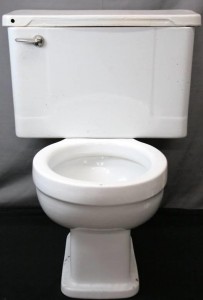
We saw yesterday what some widows do with the legacy of their venerable husbands. Salinger had declared that he wouldn’t sell the movie rights to Catcher in the Rye in order to leave that possibility to his family as inheritance – but selling his toilet and signing an authenticity letter sounds a bit excessive.

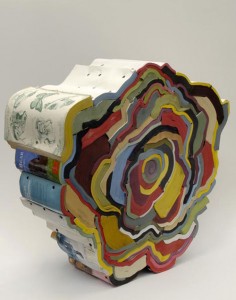
But then, the world is full of eccentric people. Today we present mancunian Jonathan Callan, who has decided that wedging a book under a table’s leg is too old a joke and has found new uses for his library. He now devotes his patience and screws to construct these pieces of, ahem, art. Sorry, I got a cough there.

No, really, I think it’s really creative – but a tad ugly too, right?

What’s the strangest thing you’ve done with a book?

Eccentrics I

Don’t be misled by the title. Even though I talked of empathy yesterday, I don’t intend to write today about the opposite, curiosity. I’m going to tell you about real-life eccentrics that have nothing to do with creative writing but they do with books – and we have a laugh, what the heck, after all it’s summer, at least in this hemisphere – if you can call that thing outside my German window “summer”.

The point is, eBay offers the possibility to bid on J. D. Salinger’s toilet. Seriously. Beware mysophobics: this article is intended for real mythomaniacs, as it comes -quote- “uncleaned” -unqoute-. So if you have a million dollars and you don’t know what to do with it, you can donate it to the workshop or -almost literally- throw it down the toilet, whatever you see fit.

But while you think about what to do with your money, others have already decided what to do with their books – though I’ll tell you that tomorrow.

And you, what memorabilia from selected authors do you treasure? Personally, the weirdest thing I remember doing was after the death of Frank McCourt, whom I had not read yet. As soon as I read about his demise, I decided to buy Angela’s Ashes, and it turned out that a seller on Amazon was selling an autographed copy for very little, so I got it before it revalued. By the way, I loved the book. But apart from a few signed copies, I don’t think I own anything too strange. Do you?

Empathy and resemblance

Un libro es un espejo
A book is a mirror?

On sesion 17 of our Spanish-language podcast we discussed how resemblance generates empathy, while difference creates curiosity: two opposite poles that we can use to attract the attention of readers. Today I’d like to emphasize the first idea with several examples.

For example romantic novels have a mainly female readership, and indeed their protagonist is most frequently a woman. Of course there’s also always a male main character to complete the couple, but the true heroin is, in 99,9% of the cases, the girl.

Similarly, tipically masculine genres like trial or spy novels are always populated by cops, lawyers and soldiers – of the masculine gender.

But we find the most evident examples in cinemas. Aren’t the protagonists in children’ movies always children? Aren’t teenagers, in horror flicks? Or women, in romantic movies? There are exceptions -as with everyhing else in life- but the standard is clear, right?

I am aware that most of my readers don’t write genre fiction or with a specific audience in mind, but rather follow literary fiction and write for themselves. That’s why I won’t advice anyone to “think about your objective audience and try to bring your protagonist as close to them as possible”, even though I could say it – in fact I just have. Instead we can also apply the rule backwards: from your main character you may infer the main body of your potential audience. Such information can be quite useful, for example when deciding what contests or publishing houses to send the work to, or who among your friends and contacts can give you an appropriate opinion, similar to your potential real readers.

As often, just a topic to think about.

Which book should I buy?

Wood or Lodge?

Time for listener’s questions:

I’ve read a couple good books on writing and I’d like to find others that study fiction in further depth. I’ve seen two available online and I’d like to know your opinion on them:

I’m afraid they might be critical articles on classical authors -when I’m not interested in literary criticism- or they may be too general or superficial.

Unfortunately I don’t know any of them. I see on Amazon that Lodge’s is a compilation of articles previously published on The Independent on sunday. Each chapter deals with one topic and illustrates it with quotes from clasics, which is probably a good idea for a structure and might waken up your appetite for further reading.  According to the back cover, Wood is not an author but a critic, and according to the table of contents, two chapters are devoted to Flaubert, which is probably a waste of pages unless you know his work. Both volumes receive generally good reviews, though Lodge’s sem to be slightly better. If I had to choose among those two, I think I’d go for Lodge, but you see it’s only a first impression. If you’re really interested? Get both.

Don’t fool yourself, though: there are hardly any “advanced” manuals for writers. I still haven’t found one that takes for granted that I know the difference between first- and third-person narration and takes on from there. They all stop to explain -and frankly, one gets sick of it. The reason why they all appeal to beginners is because by doing so they expect to reach a wider audience and sell more copies. If you know a book “for experts”, please share it in the comments!

On the other hand, one learns something from every book. Sometimes it’s a detail on structure, or perhaps a new trick for writing dialogue, or a new perspective on things we thought we already knew. As we can’t possibly learn everything from one book, the more we read, the more we’ll know.

But remember: we learn writing through reading, but mainly through writing.

Clear as vodka

Writing shouldn’t come between the reader and what’s being described.  It should be as transparent as possible.

Diana Athill

Say all you have to say in the fewest possible words, or your reader will be sure to skip them; and in the plainest possible words or he will certainly misunderstand them.

John Ruskin

The secret of popular writing is never to put more on a given page than the common reader can lap off it with no strain whatsoever on his habitually slack attention.

Ezra Pound

Second editions

Freddy Astorga sends in a question:

After you edit and publish a book, can you make a reivsion with improvements on your story, or are second editions just minor revisions?

The idea reminds me of the “director’s cuts” we often see on DVDs and even in cinemas, which for the most part are a trick to make you pay twice for about the same thing. Moviemakers have found a range of excuses for not making “their” movie from the start: studio pressure, budget limitations, tight deadlines… Excuses that a novelist cannot rely on.

The only second -and subsequent- revised editions that we find on print are reference works, but there is a reason for this. With the evolution of the world (its techonology, its laws, etc.), the text describing them needs to be updated to reflect those changes. This reasoning does not apply to fiction either.

The author is the only person responsible for their text. Therefore, correcting the finished piece would discredit their own work. A revised version can correct edition errors (like typos, or page numbering problems) but should leave the text and its universe intact. What would be the point of saying “things did not happen exactly that way, but a little more like this”? It would say very little about our capacity as narrators. Incidentally, this highlights the importance of a good editor, who should point out the flaws in you work and make sure that the published text is, from the beginning, final.